The art of impermanence / POINT REYES LIGHT
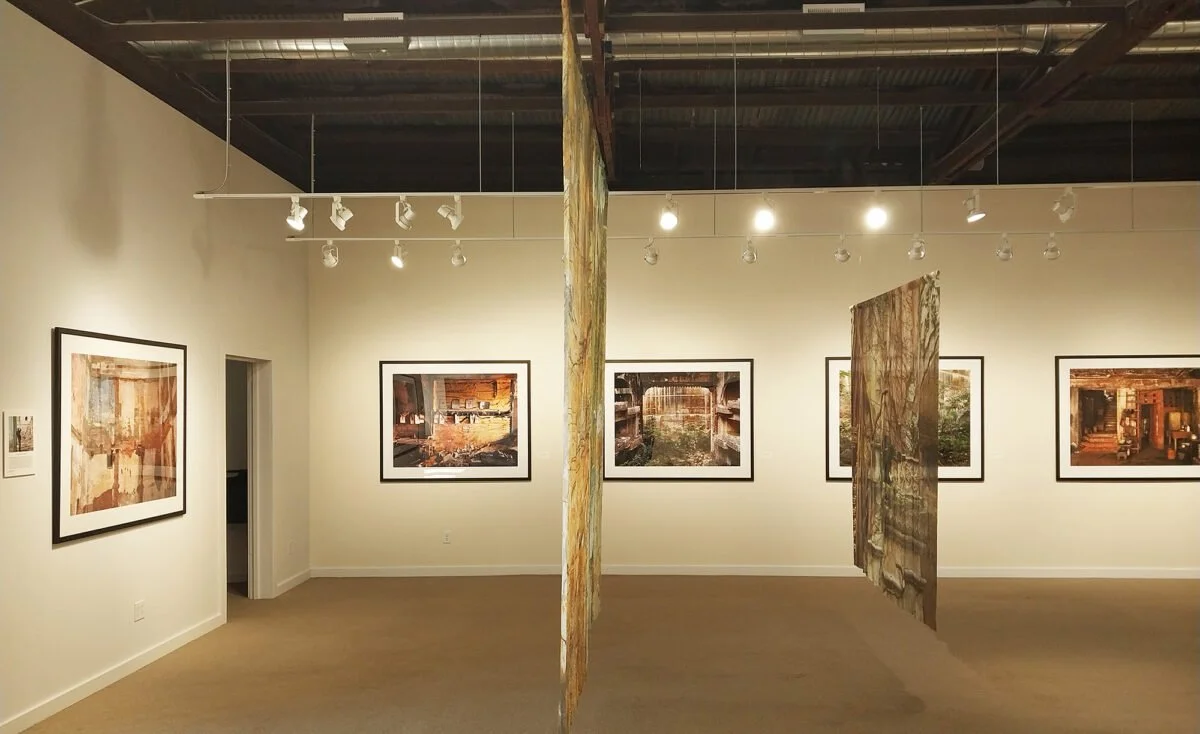
Works by Toni Littlejohn and Charles Anselmo are showing in the Russell Chatham space. (Photo by Charles Anselmo)
By Sophia Grace Carter
At first glance, Charles Anselmo’s photographs and Toni Littlejohn’s paintings seem to share little beyond their scale. His work is an elegiac survey of modern-day ruins; hers, a primordial meditation on the earth’s surface and the vastness beyond. Yet both artists, who are also partners, share a visual language that locates human presence precisely in its absence.
Their large-scale, immersive works fill the Russell Chatham space in Point Reyes Station through Nov. 16. Mr. Anselmo recently took over the space, where he plans to mount a rotating series of exhibitions featuring painters and photographers, many drawn from the Bay Area.
In “Memoria Eidética,” Mr. Anselmo captures post-Katrina New Orleans, the city then an architectural morgue, and Havana, Cuba, where over half a century of isolation has wrapped the capital in decay. Few places in the world, however, brim with as much life. One image captures Havana’s Teatro Campoamor, a moldering baroque shell overtaken by lichen, palms and vines. The theater lived several lives—as an opera house, then a cinema, then a comedy venue, and finally a parking garage—before succumbing to nature.
“I’m photographing artifacts that bear an imprinted memory,” Mr. Anselmo said. “Cuba addresses this so exquisitely because it isn’t really an abandoned place. It’s a major capital city in a state of living decline, and that living decline gives it an element that makes it something beyond the trope of abandoned places.”
He warns against what he calls “the pleasure of ruins”—photographs that aestheticize decay without context. Rather, he thinks of his work as “an archeology of loss,” saturated with social meaning and historical depth.
Suspended through the center of the gallery are seven-and-a-half-by-10-foot habotai silks, a fabric traditionally used for kimonos, printed with his photographs. Their rippling translucence lends the architectural images of stone, tile, glass and concrete a fleeting, weightless quality.
A former painter, Mr. Anselmo turned to photography after a rattlesnake bite in Utah left his dominant hand severely damaged. Retraining himself to work right-handed, he began experimenting with photography and was quickly drawn to the poetry of metropolitan entropy.
Working primarily with medium-format and 4×5 film, he moves deliberately, producing 10 exposures on a busy day. Since 2000, Mr. Anselmo has returned frequently to Cuba, becoming the first American to hold a solo exhibition at the Fototeca de Cuba, the country’s national photography museum.
Across the room, Ms. Littlejohn’s “In Earth’s Embrace,” epic poured canvases inspired by her meditation practice, depict an entirely abstract subaqueous realm, where sea and sky dissolve into one another. In works like “Terra Firma” and “White’s Thrust,” she tilts her canvases to coax pools of latex enamel across the surface, pushing and pulling the pigments to create volcanic and glacial landscapes. The process is both precise and fluid: she knows where the paint should land but surrenders to its diffusion and atmospheric drift. “I felt like I was creating river deltas,” she said.
Her artistic practice, drawing from Tibetan meditation, begins with lying on the ground and feeling the earth’s energy. “Because I was doing that, I felt like the whole orientation of my work was to be expressive of the earth,” she said. “It wasn’t a conscious decision—it was just happening.”
Together, their works form a contemplation on impermanence: hers focused on the slow renewal of the natural world, his on the aftermath of man’s folly. “While Toni engenders this sense of transformation and revitalizing, I’m more involved in the effects of human events,” Mr. Anselmo said. “We’re extracting resources, committing incredible crimes of enduring arrogance. I photograph the remains of those grand designs—perfect things rendered imperfect.”